“Women in Wakefield” Revolutionary War edition!
As we enter the 250th anniversary of the Revolutionary War, it seems fitting to dedicate one of our Women’s History Month tributes to the town’s women during that period.
The war actually lasted for seven long years, from Concord and Lexington past the battle of Yorktown, but the early period was probably the most terrifying for women of our region. After all, the British were in Boston!
It’s been estimated that, throughout the course of the War, at any given time, 400 men from the town of Reading were in the Army. (Remember — “Reading” at that time encompassed Wakefield, Reading and North Reading.) Since the overall population was not large here to start with, this represented a significant dent in the town. The cities and towns were expected to contribute not only money, but firearms, food and firewood to the effort, especially during the early period when the war was nearby. Our town had to take out a loan to meet its obligations. Food and ammunition were stored in the meeting house and the schoolhouse on the Common. Evacuees from Boston and Charlestown were also being housed here. Later on, Scottish prisoners of war would be stationed here as well. We had become a hub for ammunition and supplies, making us more vulnerable. At several points, the town’s militia was called to respond toward hotspots from Lexington to Salem, where the British were seeking to seize some cannon.
After men had mustered into the Continental Army, women had to shoulder a lot of the responsibilities usually taken care of by their husbands, sons and fathers. Let’s take a look at a touching letter sent home to a woman whose home was nestled approximately in the location of Lucius Beebe’s estate at Lakeside (near “Beebe’s Cove.”)
It was sent by Benjamin Brown, a colonel in the army, who commanded 400-500 men at some engagements, under the command of General Gates. 48-year old Benjamin Brown was an important person in our community; he had served in many public offices and would later rise to the rank of general in the town’s cavalry and be elected our representative in the General Court. He was a widower in 1772 when he married Elizabeth (Sprague) Wiley, who was a widow herself. The Brown family did some farming, but his primary occupation was as a tanner.
His letter is headed “Ticonderoga, August 31, 1776.”
After a loving greeting he writes: “You tell me you have purchased some Hemlock bark; I am glad to hear it, and hope that the tanning and currying may be done well and seasonably, which will greatly contribute to the support of the family.”
He then sends news of fellow soldiers and messages to family and friends, adding: “I understand by you that the little General (referring probably to an infant son, then about ten months old, who
was named for Gen. Joseph Warren) is your bedfellow ; I hope you will nourish him and make a fine fellow of him, til I return and take part of your soft bed, with him and you; for the softest bed I have is boards, and sometimes hemlock boughs.”
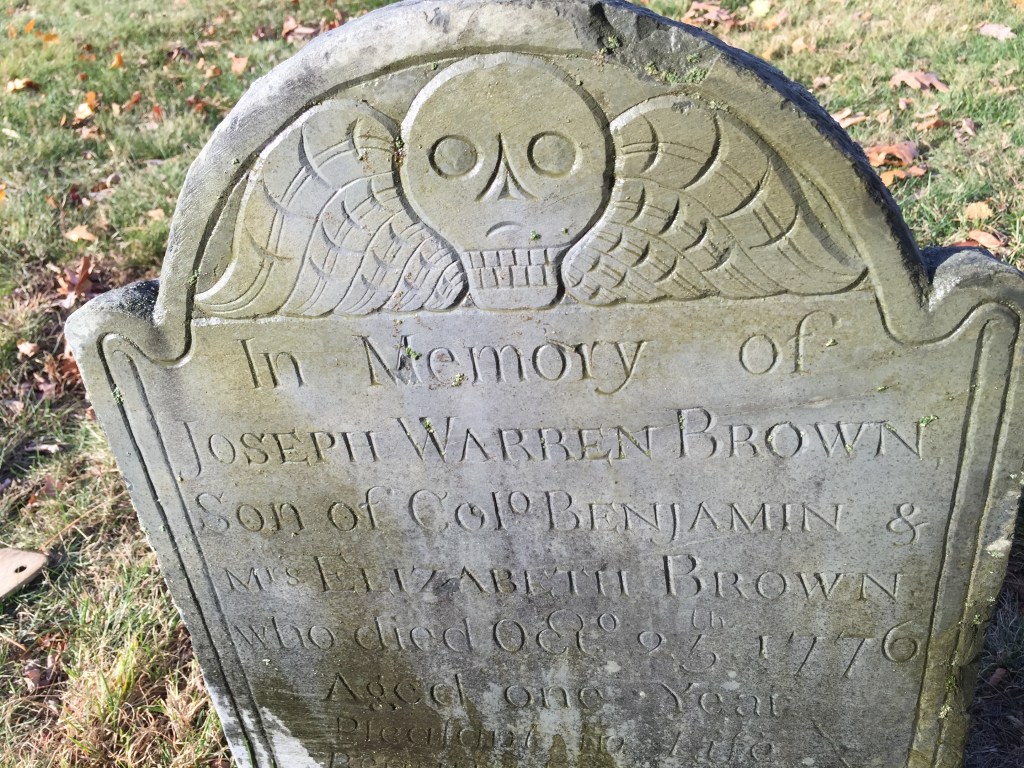
Sadly, little Joseph Warren Brown (born in 1775) only survived another two months; he died on the 25th of October in 1776, where his gravestone stands quite close to that of his father and mother. (See his gravestone at the end of this post.)
If you have been enjoying these profiles, please follow Wakefield Historical Society. All the posts will be featured on our social media posts as well as on our blog at http://www.wakefieldhistory.org. Many are being featured by the Wakefield Daily Item. #WomensHistoryMonth


 Wakefield Historical Society