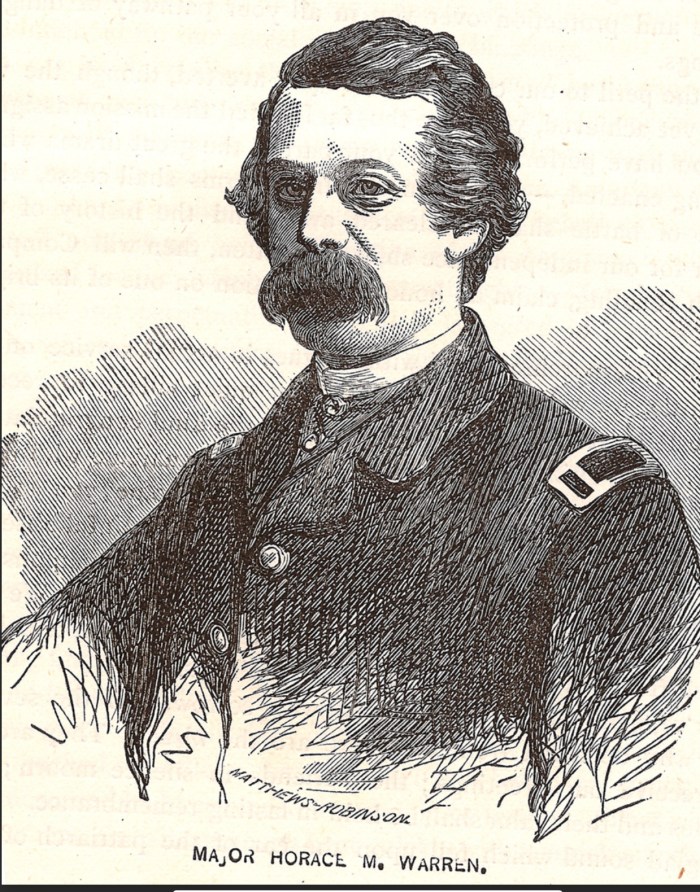
It is my honor to introduce you to one of South Reading’s hometown heroes, Horace M. Warren.
Horace was born in Topsham, Maine on July 8, 1841, one of six children of Edwin R. and Mary Hathorne Warren. The family was proud to be lineal descendants of Moses Warren who had fought at Bunker Hill and at Dorchester Heights during the Revolution.
The entire family moved to South Reading in 1860; two of his brother were listed as seamen working on whaling ships out of New Bedford; his sister was a music teacher, but at 18, Horace was a clerk.
In 1861, President Abraham Lincoln called for a party of 3-month volunteers. Horace was 19, and he immediately joined the force.
He was one of 79 South Reading ‘minute men’ who answered that initial call in April of 1861. Their company would be attached to the 5th Massachusetts Regiment at Company B. Their 90-day service was one week from expiring when the Army was ordered to move against the Confederate forces at Manasas. As the Battle of Bull Run began, the South Reading soldiers got their first taste of battle. Several were wounded, and three were imprisoned at the disastrous battle.
The volunteers from South Reading were mustered out of service soon after but Private Warren almost immediately re-enlisted, this time as a 1st Sergeant of the Co. E. 20th Massachusetts Regiment.
He was sent back to Virginia and just 3 months later, at the fierce battle of Ball’s Bluff, Virginia, his superior officers were killed on the battlefield. The 20-year old Sergeant Warren found himself in command of his company. The Union losses that day were considerable: Over 200 had been shot, among them a grandson of Paul Revere, a son of Oliver Wendell Holmes. While leading his men, Sergeant Warren was seriously wounded.
The surgeon doing triage on the wounded doubted that Warren could survive, and ordered him left behind so that attention could be paid to those with a better chance of survival. But his men rejected that — they sheltered their Sergeant, bundling him into a boat to transport him, in the pouring rain, across the Potomac and somehow keeping him alive until they could finally get to a hospital.
In January of the following year, he was considered well enough to make the journey home. He had been wounded in the arm, the leg and the body; his left arm was virtually useless. Wracked by his injuries and nearly emaciated, he had returned home a very different man than the idealistic boy who had left South Reading a mere five months before. During his time at home he served as a pallbearer for Captain Thomas McKay, who had been murdered by a drunken recruit, being buried from the First Parish Church.
In August, however, another call for volunteers was made, and Horace was determined to serve once again. He was elected First Lieutenant of the Company, which was this time assigned to the Massachusetts 50th under the command of General Banks in the Department of the Gulf. The company served during the siege of Port Hudson, under continuous fire for 42 days. When the rest of his colleagues mustered out, Warren was offered the position of adjutant in Company S, 59th Regiment, under Colonel Jacob Gould. Commissioned an officer, he stayed with the Regiment through a series of skirmishes and battles including the battle of Spottsylvania.
At Cold Harbor, Warren was once again wounded, but he stayed with his Regiment. After Lt. Colonel Hodges was killed, Horace Warren acted as Assistant Adjutant General. The rank of major was conferred upon him.
The war was raging and Major Warren was in the thick of it. General Grant was determined to take Richmond. The Petersburg campaign brought a furious fight for the capture of the Weldon Railroad line from August 18 – 21. During a skirmish in this campaign, a fatal bullet would find Major Warren.
He died on August 27, 1864, eight days after he was wounded. He had just turned 23.
His funeral and burial were held at the First Parish. Flags flew at half mast on the day of his funeral. Schools and shops were closed on this day, in honor of this son of South Reading who had fought so valiantly and had made the supreme sacrifice. Families all over town were anxious to get his photograph to keep in their family albums.
The Warren family was one of six South Reading families to send three sons to the War of Rebellion, and one of only three South Reading families to lose two sons in the War. Alvin S. Warren, two years younger than Horace, had died of fever at Fortress Monroe in June 12, 1862. The eldest of the Warren boys, Edwin R. Warren, served in the Navy during the War, and would survive to return home after the War.
In 1867, after the conclusion of the War, the town’s Grand Army of the Republic (GAR) post would be established and would take the name “H.M. Warren Post.” In 1896, the Town of Wakefield voted to erect a fine new brick school on Converse Street. The School Committee had chosen to name the new school the “Highland School,” but the Town Meeting rejected the name, opting instead to name the new building the H.M. Warren School after our hometown hero.
The story of Major Warren is the story of a local boy who believed in the ideals and the values of this nation. Although little more than a boy, he exhibited valor on the battlefield and for his country he made the supreme sacrifice. His story is just one of 47 of the South Reading boys and men who died in the War of the Rebellion and whose memories are honored here in this magnificent monument.


